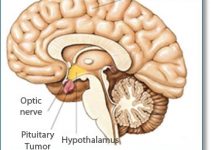

The pineal gland hangs on the brain behind its very center. French 18th-century scientist Rene Descartes thought that the pineal gland was the core of the soul, noting that it was the only unpaired organ in the body, and located in the center of the brain.
He thought that the gland controlled the movement of the various body “humor.” In fact, the pineal gland is the “third eye” of the brain and is responsible for telling the brain when it is day or night.
It also controls the body's hormonal systems, sleep-wake cycle, and other so-called “circadian” body rhythms. It is, in essence, the body's internal clock.
The gland produces a hormone called melatonin, (now a popular over-the-counter product).
Melatonin levels are what directly influence the function of various brain centers (appetite, sleep, the hypothalamus, and pituitary gland).
The cells of the pineal gland are unique in that they are not related to either the support cells of the brain (e.g. astrocytes) nor to the brain neurons. Rather, they develop on their own. For this reason, true pineal cell tumors are quite different from other brain tumors.
The pineal gland is also filled with brain support cells (astrocytes) and has a very dense input of nerve fibers coming from the eyes via a circuitous and complicated route.
Thus, the tumors of the astrocyte support cells of the pineal region are the same as the astrocytomas and GBM.
Pineal tumors, themselves, vary. They include:
- Pinealocytoma (“benign” pineal cell tumor)
- Pineoblastoma (more aggressive pineal cell tumor)
- Pineal germinoma ( aggressive primitive cell tumor growing in the pineal region)
- Pineal teratomas (rare tumors of multiple cell types that grow in the pineal region)
- Pineal Cysts (most often not treated, unless large enough to cause hydrocephalus or visual symptoms)
Diagnosis
A combination of CAT scan, MRI, and spinal fluid studies (including “markers” such as AFP, and spinal fluid cytology), will help the surgeon to deliver a very good guess or outright diagnosis.
Treatment Decisions — Tumor Biopsy
With all of these possibilities in such a small area, it is no wonder that most physicians feel strongly that at least a biopsy should be taken prior to considering a treatment course.
- Surgical Removal. These tumors should be approached surgically at first, with the best effort to remove as much of the tumor as possible. With current surgical techniques, the risk has been reduced to well below the 2% mark, making the decision to operate much less difficult than it was previously. Today, the surgery can be minimized so that recovery time is shortened. Some patients with larger tumors may also develop hydrocephalus, requiring the placement of a shunt at the time of surgery or thereafter.
- Radiation. Some centers perform radiation, at least in a “test” dose (in the case of a germinoma). Since some of the primitive tumors are quite sensitive, a full course of radiation might be considered.
- Craniospinal axis. If the spinal fluid cytology is positive, the so-called “craniospinal” axis therapy may be considered. This is done because some of these tumors will “seed” down from the brain into the spinal canal.
- Chemotherapy. Many chemotherapy choices are available. Some of these tumors are quite sensitive to chemotherapy, accounting for the vigorous chemo-approach of many neurooncologists to such lesions.